Stock
The stock sets length of pull, cheek position, recoil interface, and balance.
INTERFACE REVIEW
Confirm receiver attachment, user fit, and lawful configuration.
RESEARCH STARTING POINTS
Recognizable platform imagery, selectable component systems, brand and gear connections, build paths, and responsible public technical guidance.
A pump-action shotgun is organized around the receiver, bolt and action bars, fore-end, barrel, tubular magazine, trigger group, stock, sights, and model-specific accessory interfaces.
8 SELECTABLE COMPONENT SYSTEMS
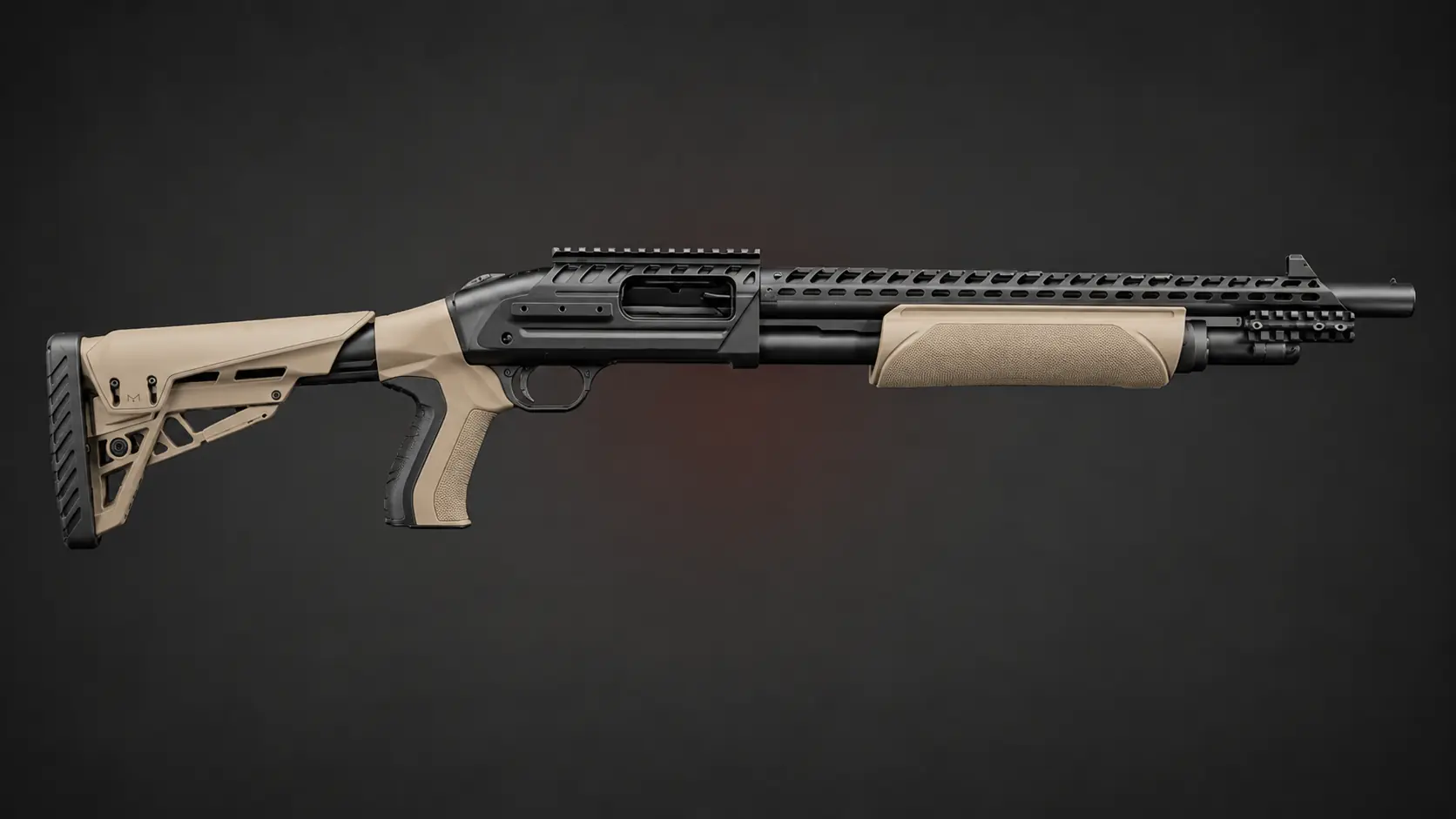
The stock sets length of pull, cheek position, recoil interface, and balance.
Confirm receiver attachment, user fit, and lawful configuration.
Public technical orientation—not assembly instruction. Exact dimensions, interfaces, specifications, service procedures, and lawful configuration are model and jurisdiction dependent. Use current manufacturer documentation and a qualified armorer or gunsmith where appropriate.
Pump-shotgun service begins with a complete chamber and magazine-tube check. Barrel removal is often straightforward, but receiver, shell-latch, trigger-group, bolt, and fore-end procedures differ substantially by model.
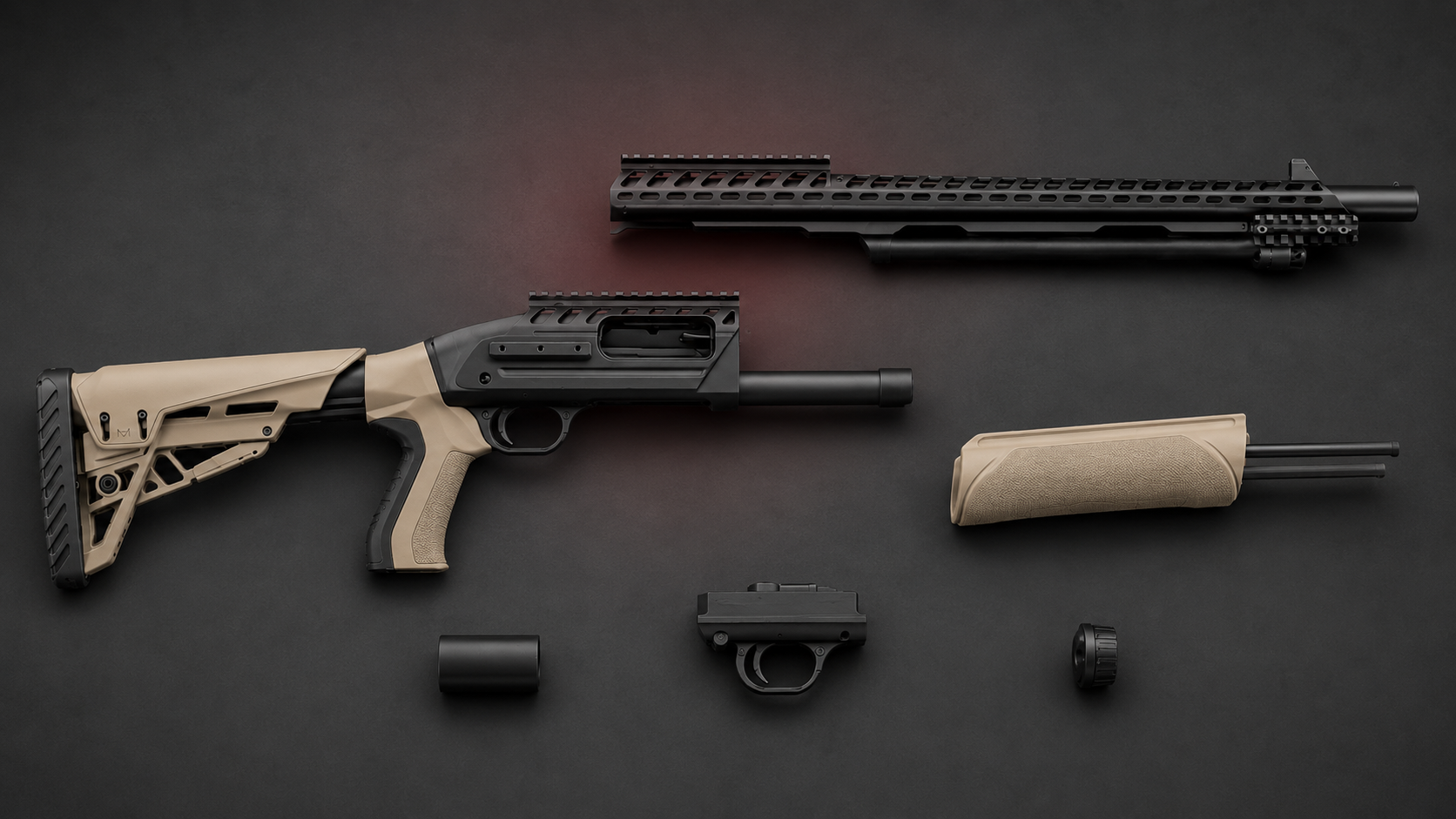
Keep the muzzle safe and engage the safety as the manual directs. Operate the action release, open the action, remove every shell from the chamber and magazine tube, and inspect the chamber, elevator or lifter area, loading port, and magazine follower. Physically confirm the tube contains no shell.
Cycling the action once does not prove a tubular magazine is empty. Count and account for every shell.
This guide is a platform-level orientation to ordinary field stripping only. Before disassembly, use the manufacturer’s current manual for the exact make, model, caliber or gauge, generation, configuration, specifications, safety instructions, and function-check sequence. Stop if the firearm differs from the description, a part resists normal hand pressure, or damage is suspected. Detailed bolt, trigger, firing-pin, extractor, ejector, gas-system, magazine-tube, headspace, timing, or fitted-component work belongs to a qualified armorer or gunsmith.
Every system in the diagram connects to a dedicated gear or component workspace.
Editorial starting points for model-specific research—not universal rankings, guarantees, or substitutes for compatibility review.
Use cases describe planning contexts only. The complete configuration, user, environment, and applicable law control suitability.
PLATFORM IMAGE: User-Supplied Pump Shotgun Reference ↗ · Supplied for the DeadEye Syndicate technical display. Displayed as a neutral technical reference; manufacturer and creator endorsement is not implied.