AR15 terminology glossary
Plain-language definitions of recurring terms, with source pages and contextual qualifications.
REFERENCE PAGESPrinted pages: 6 to 9; 12 to 15; 26 to 27; 48 to 51; 80 to 81UPLOADED SCANPDF pages: 4 to 7; 10 to 13; 24 to 25; 46 to 49; 78 to 79
A vocabulary reference
These short editorial definitions draw on the book's anatomy, introductory chapters, and glossary. They support identification and reading comprehension. They do not establish interchangeability, legal classification, service specifications, or safe operating condition.
 OPEN FULL SIZE ↗
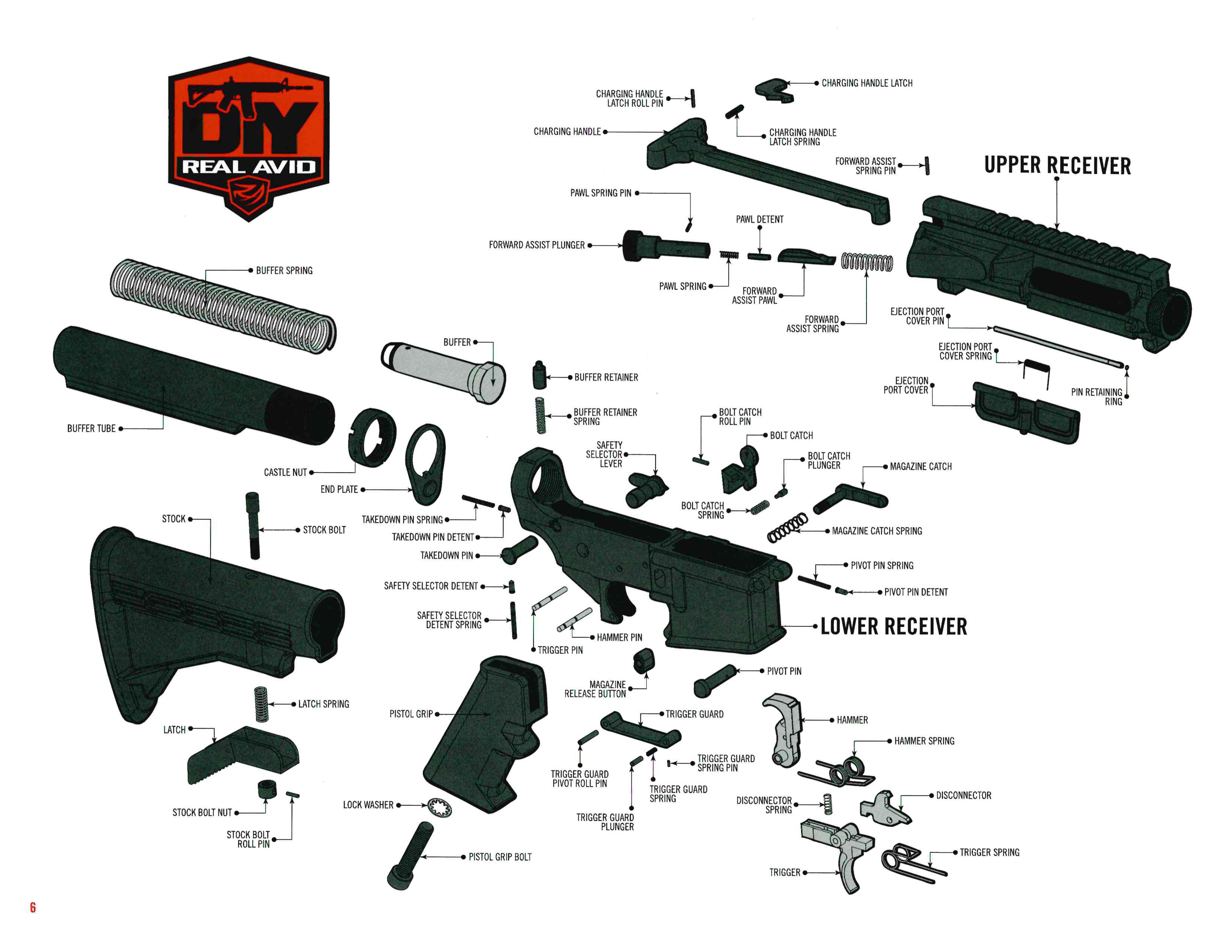
Labeled source illustration of upper and lower receivers, rear support components, and controls.
Source image: Real Avid, Top AR15 Mods, ©2021. PDF page 4.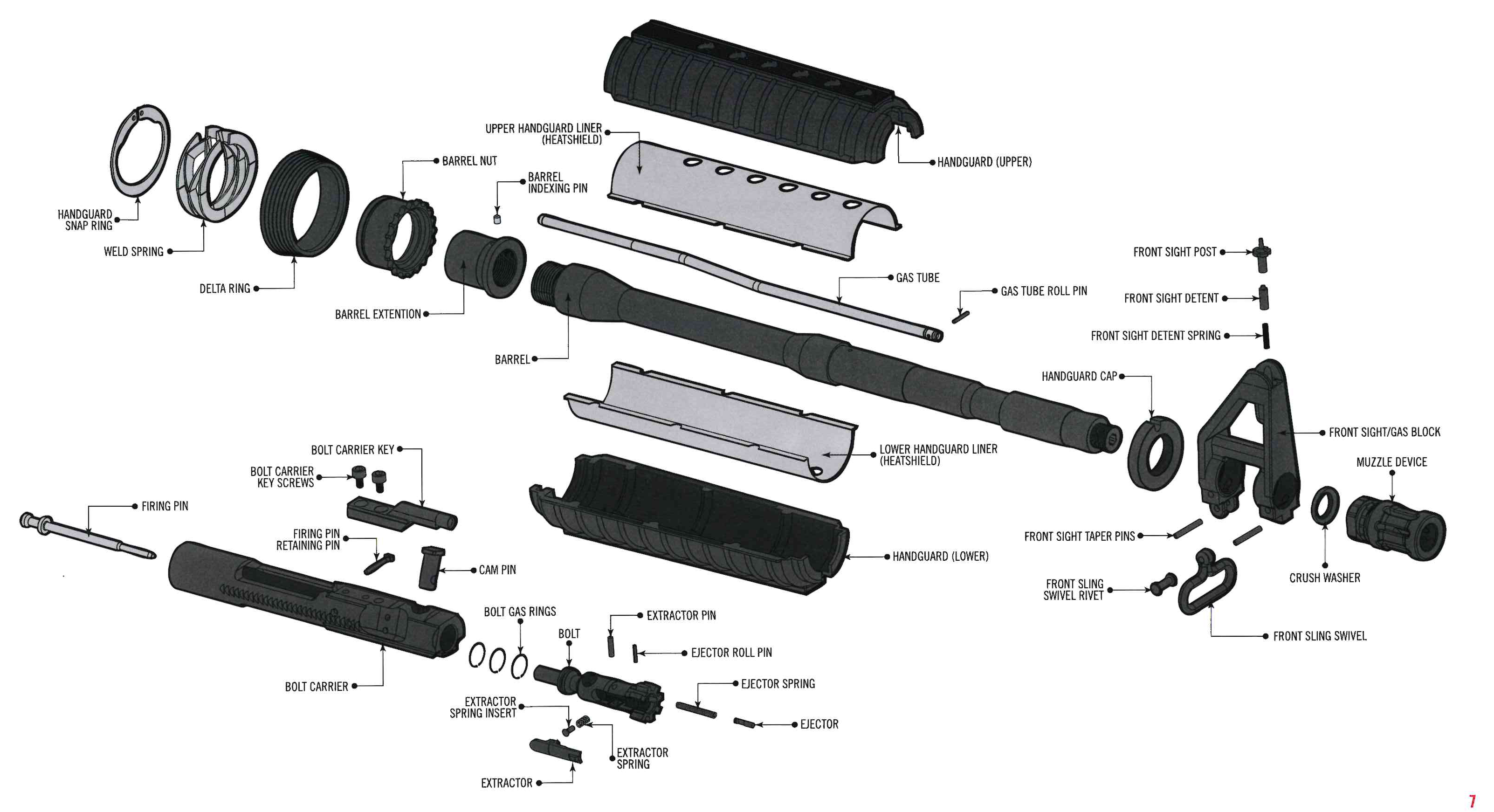 OPEN FULL SIZE ↗
Labeled source illustration of the barrel, handguard, and bolt carrier components.
Source image: Real Avid, Top AR15 Mods, ©2021. PDF page 5.KEY TAKEAWAY
A shared term is a starting point for a question, not a substitute for a model-specific answer.
Find a term
24 terms
- ArmaLite / AR
- ArmaLite is associated with the original AR designs; AR refers to ArmaLite Rifle.Source book, printed pages 10 to 11; 80.
- Bolt
- The locking component associated with the chamber; one part of the bolt carrier group.Source book, printed pages 6 to 9; 80.
- Bolt carrier group (BCG)
- An assembly containing the bolt, carrier, and associated internal components.Source book, printed pages 6 to 9; 80.
- Bore
- The interior passage through the barrel.Source book, printed pages 80.
- Buffer
- A component of the rear action system in common AR15 configurations.Source book, printed pages 56 to 59; 80.
- Chamber
- The part of the barrel shaped to accommodate the specified cartridge.Source book, printed pages 14 to 15; 26 to 27.
- Charging handle
- The manual handle associated with movement of the bolt carrier assembly.Source book, printed pages 6 to 9; 80.
- Delta ring
- Part of the retention arrangement used with certain traditional two-piece handguards.Source book, printed pages 40 to 43; 80.
- Direct gas impingement
- The book's term for the common AR system that routes operating gas rearward to the carrier assembly.Source book, printed pages 12 to 13; 80.
- Eye relief
- The viewing distance associated with obtaining the intended image through an optic.Source book, printed pages 50 to 51.
- Fire-control group
- The trigger, hammer, disconnector, and associated components involved in controlling firing.Source book, printed pages 70 to 73; 80.
- Free-float handguard
- A handguard arrangement designed to avoid contact with the barrel along its length.Source book, printed pages 40 to 43; 80.
- Headspace
- The relationship between the closed bolt face and a defined reference surface in the chamber.Source book, printed pages 26 to 27; 80 to 81.
- Lower receiver
- The lower structural housing with the magazine well and interfaces for the fire-control and rear support systems.Source book, printed pages 6 to 9; 81.
- Mil-spec
- A reference to a military specification; a commercial claim needs the actual applicable specification and scope identified.Source book, printed pages 18 to 19; 81.
- Muzzle
- The forward end of the barrel.Source book, printed pages 81.
- Muzzle device
- A broad category of devices at the muzzle. Specific device names describe different functions and should not be treated as synonyms.Source book, printed pages 52 to 53; 81.
- Receiver extension
- The component commonly called the buffer tube in conventional AR15 descriptions.Source book, printed pages 56 to 59.
- Reticle
- The aiming reference visible through an optical sight.Source book, printed pages 50 to 51; 81.
- Rifling
- The spiral lands and grooves inside a rifled barrel.Source book, printed pages 81.
- Roll pin
- A spring-type retaining pin, distinct from a solid pin.Source book, printed pages 81.
- Short-stroke piston
- An operating-system arrangement using a piston mechanism to transfer force to the action.Source book, printed pages 12 to 13; 81.
- Trigger guard
- The guard surrounding the trigger area; a different component from the trigger mechanism.Source book, printed pages 66 to 67.
- Upper receiver
- The upper housing associated with the bolt carrier assembly and the barrel and handguard interfaces.Source book, printed pages 6 to 9; 81.